News
AI in the classroom: preserving inquiry in an age when machines are thinking for us
Policy for Science
Sustainable Development Goals
Artificial intelligence is reshaping how students learn and how teachers teach. It can help teachers design innovative curricula, yet it also poses real risks to inquiry-based science education (IBSE) and to the development of students' critical thinking. AI was a recurring theme throughout the IAP–ISSE school A Strategy for Science Education in a Changing World, held in Erice from 16 to 19 October 2026. It was also the focus of the panel "Education in the Age of Artificial Intelligence," where Mary Burns, Visiting Professor on AI in Education at the University of Turin, Italy, spoke on "Artificial Intelligence in Education: Opportunities, Risks, and the Road Ahead."
We asked Mary about the risks and potential of AI for science education, what lies ahead in the classroom, and what it means for educators and policymakers.
You've warned about the risks of AI in the classroom. What does that mean for science education? Is AI a threat to inquiry-based learning, or could it support it?
There is evidence in both directions. One risk is that AI lets students skip the effortful part of inquiry. I'll point to one study of 63 middle schoolers conducting science investigations with ChatGPT. The researchers found that students often stopped inquiring without asking a follow-up question. They also could not tell strong prompts from weak ones and missed vague AI explanations.
Knowledge is foundational to science, and large language models may already be eroding students' domain knowledge, resulting in what some call cognitive "atrophy". To do inquiry well, and to use AI to augment rather than replace thinking, students need foundational skills such as literacy, and solid domain knowledge.
On the other hand, a generative chatbot that prompts metacognitive reflection may support inquiry and improve science knowledge. But such gains depend on careful design for active thinking. Novice learners need a prior conceptual framework; they are not scientists. This is why research warns against confusing teaching science as inquiry with teaching science by inquiry. The real question is whether AI is designed to keep students doing the thinking. Our task as educators is to preserve inquiry in an age when machines are thinking for us.
How can we prepare teachers to face the challenges AI brings to education?
I'm fond of quoting the International Society for Technology in Education's admonition that "there are no AI-literate students without AI-literate teachers."
Teachers need hands-on experience with AI and need to see models of good AI-embedded instruction and assessment during their initial preparation and continuous professional development. Yet the university faculty who prepare teachers are themselves still learning how to integrate AI into instruction, so there is a lack of guidance and models.
Teachers need to learn how to use AI tools, but they also need a more holistic AI literacy. This ranges from ethics and responsible use to an understanding of how these systems work and how they shape human thinking and behaviour. Above all, teachers need high-quality professional development that helps them judge when AI strengthens learning and when it should be set aside, so they can design both AI-integrated and deliberately AI-free teaching. Most teachers do not receive this kind of support.
We know what work in teacher trainings: a focus on content and pedagogy rather than just the technology, so that teachers can verify AI outputs; active participation, where teachers try, design, reflect and revise; communities of practice in which teachers learn from teachers; and sustained support over time through coaching and mentoring.
When technology companies offer teacher training, the focus can fall mainly on using their own tools, often through one-off workshops, which research shows rarely lead to lasting change in practice. Teachers also need a broader understanding of AI literacy that goes beyond any single product.
Education policies are mostly national, but the challenges are global. How does international cooperation help address the challenges of AI in science education?
International cooperation on AI is essential, but in education it is less straightforward, because education systems are organised so differently. What cooperation can offer is shared frameworks and evidence that national systems can adapt to their own contexts, such as the OECD and European Commission's AI Literacy Framework for Primary and Secondary Education, the Council of Europe's Framework Convention on Artificial Intelligence, and UNESCO's AI competency frameworks for students and teachers. These are especially valuable for countries that lack the capacity to develop their own guidelines. But cooperation is not automatically helpful: frameworks often lack consensus, stay at the level of blueprints and can sometimes be shaped by the interests of those who fund them. Ultimately, it is in the classroom, and with teachers, that their relevance is decided.
What will happen in the classroom two to three years from now, and what should teachers be doing differently?
It is hard to forecast, but I expect more agentic use of AI in classrooms, which makes building student judgement, metacognitive skills and domain knowledge more critical than ever, with teachers as partners and drivers of AI. AI will also monitor and tailor learning more closely for each student, which could free teachers to focus on coaching and planning, much as nurse practitioners now handle routine care so that physicians can concentrate on complex cases.
Assessment will continue to shift from "Did AI do this?" to "What intellectual work did the student actually perform?" For teachers, this means focusing less on policing AI use and more on building students' judgement, domain knowledge and ability to question what AI tells them.
There is a risk that more teachers could leave the profession as AI takes over the creative and relational parts of the work that make teaching so rewarding. And we may see an AI "education bubble": in the classic technology hype cycle, AI in education may fail to live up to its promise, or even harm learning outcomes. If and when that happens, we can anticipate the inevitable blaming the teachers for technology’s shortcomings.
The message from Mary Burns, and from Erice as a whole, is that AI must support students' thinking, not replace it.
IAP and ISSE now aim to carry this forward, starting with a framework and guidance tool to help teachers, curriculum developers and education decision-makers decide when and how AI should support students' learning in science, shaped by teachers' and students' own voices.
Mary Burns is an international expert in educational technology and teacher training. She was the lead author of the Brookings Global Task Force on AI in Education report, A New Direction for Students in an AI World: Prosper, Prepare, Protect (2026). She has co-authored four books and more than 300 articles and book chapters on technology-embedded teacher professional development. She is currently co-editing Unlocking Research: Illuminating Digital Futures in Education (2027) with colleagues at the University of Cambridge.
The views expressed are those of the interviewee and do not necessarily reflect those of IAP.

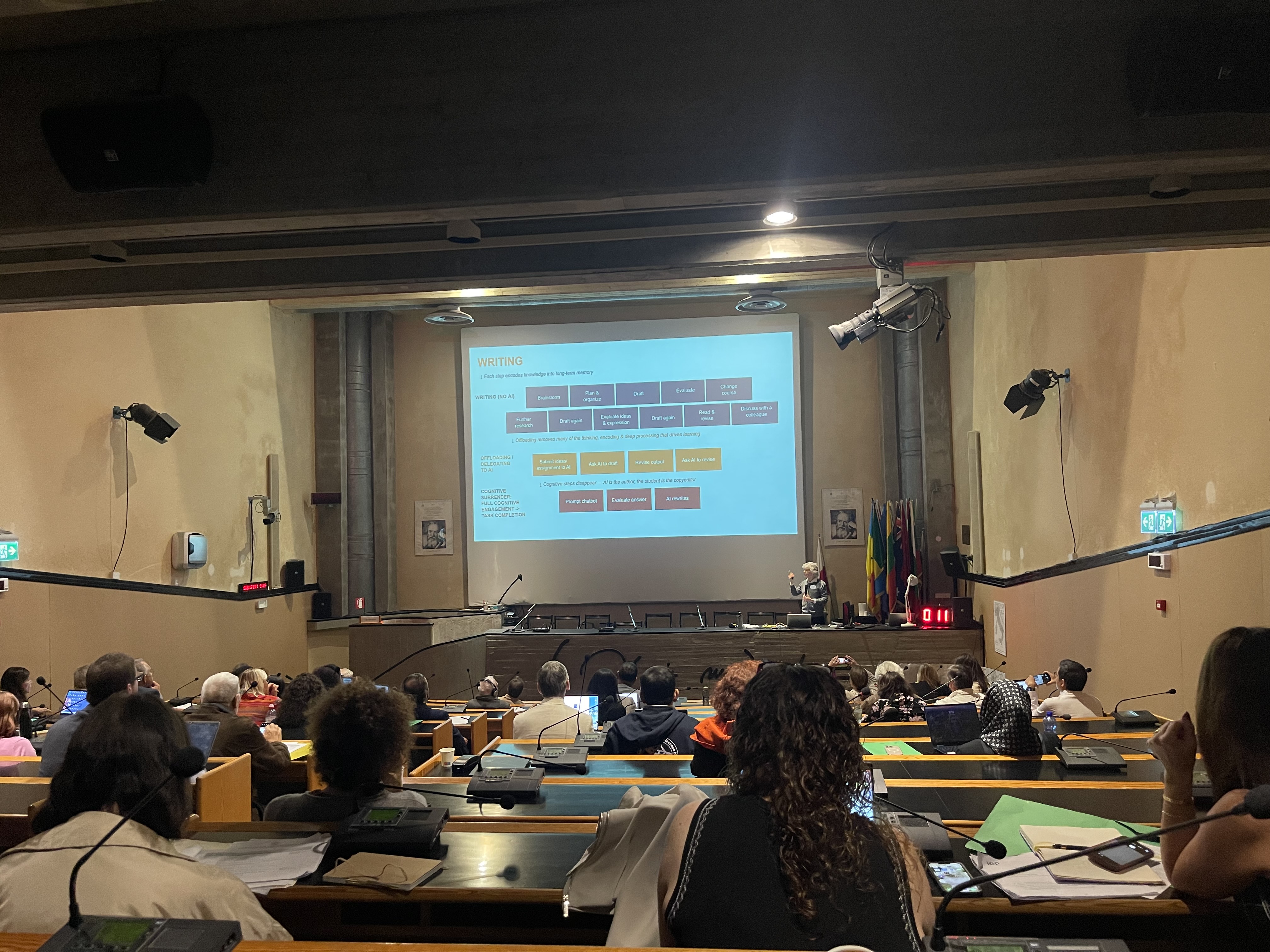 Mary Burns giving her lecture at the 2026 IAP-ISSE School
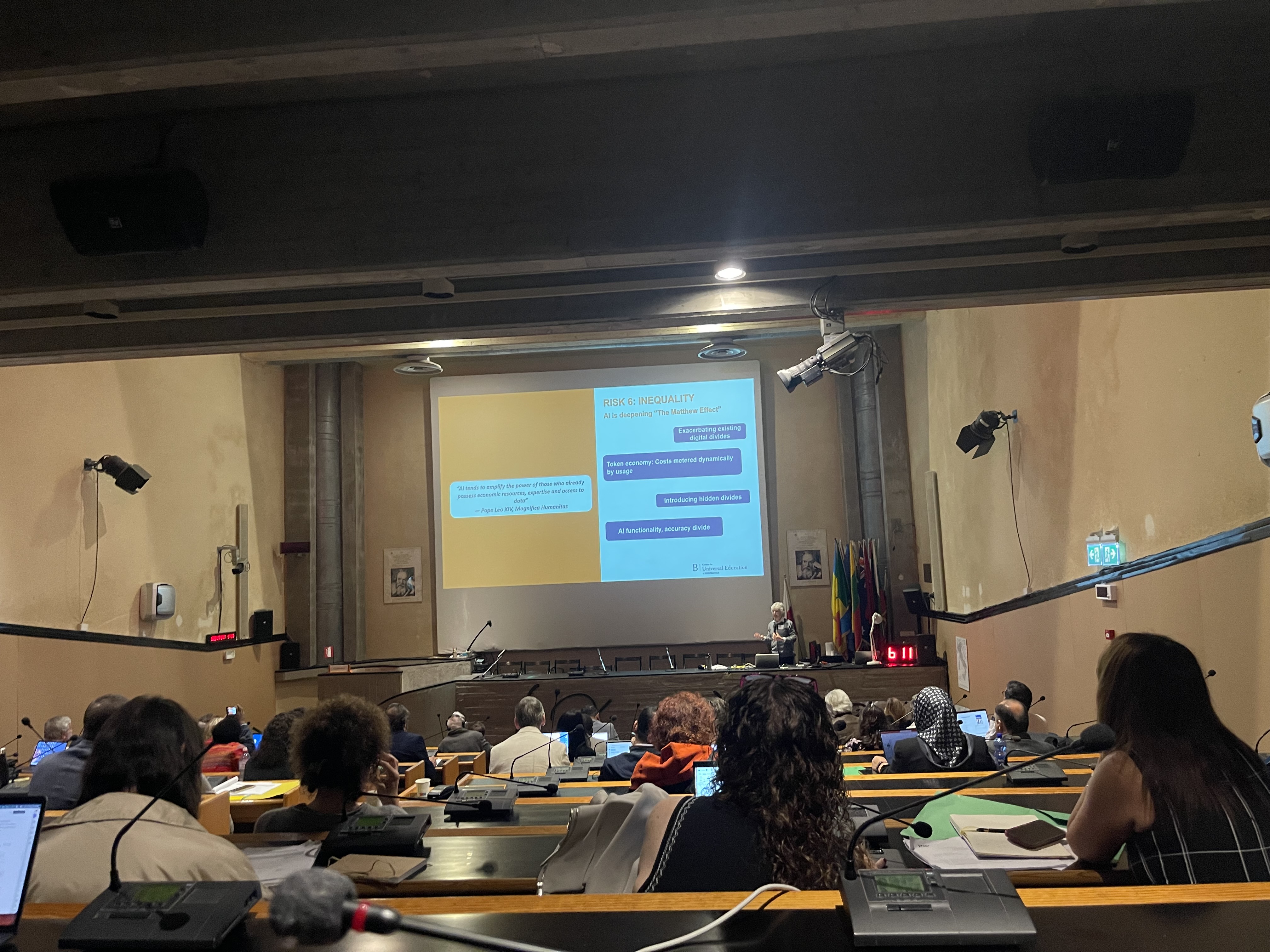 Mary Burns giving her lecture at the 2026 IAP-ISSE School