News
Climate Pressure Mounts on the Eastern Mediterranean, New Scientific Report Warns
Environment & Climate
The Eastern Mediterranean is one of the world's fastest-warming regions, with temperatures rising nearly twice as fast as the global average. Its marine environment is increasingly affected by marine heatwaves, sea-level rise, ocean acidification, invasive species and other climate-related pressures that threaten biodiversity, fisheries, coastal communities, tourism and cultural heritage. A new international scientific assessment calls for stronger scientific cooperation, expanded monitoring and coordinated adaptation to help build resilience across this shared and rapidly changing region.
*************************************************
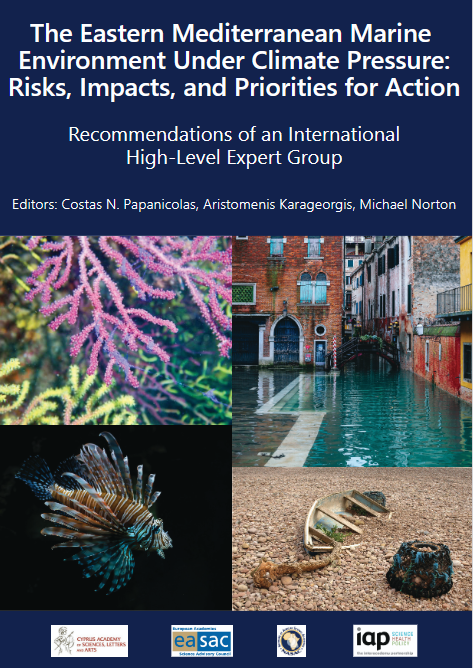
A new report from the European Academies' Science Advisory Council (EASAC), the Cyprus Academy of Sciences, Letters and Arts and the Network of African Science Academies (NASAC) examines how climate change is reshaping the Eastern Mediterranean marine environment and identifies priorities for research, policy as well as regional cooperation. The project was supported through a competitive grant from the IAP.
The report, 'The Eastern Mediterranean Marine Environment Under Climate Pressure: Risks, Impacts and Priorities for Action', concludes that climate-related changes are accelerating across the region. Marine heatwaves are becoming more frequent and intense, sea levels continue to rise and ocean acidification is increasing. Together, these changes are placing growing pressure on marine ecosystems and the communities and economies that depend on them.
The assessment also highlights the rapid spread of invasive species, particularly through the Suez Canal, as warmer waters create favourable conditions for tropical species to establish themselves. Combined with habitat degradation and other environmental pressures, these changes are altering marine biodiversity and ecosystem functioning throughout the region.
The report warns that climate impacts are already affecting fisheries, aquaculture, tourism, coastal infrastructure and cultural heritage. Marine heatwaves, harmful algal blooms and changes in species distribution present growing challenges for food security and livelihoods, while sea-level rise poses long-term risks for densely populated coastal areas.
To strengthen resilience, the report recommends expanding marine observation and monitoring systems, improving climate modelling and early warning systems, strengthening the management of marine protected areas and supporting adaptation in fisheries and aquaculture. It also calls for greater investment in scientific infrastructure and stronger collaboration between countries to improve data sharing, research and evidence-based policymaking.
The authors note that many parts of the Eastern Mediterranean, particularly along the southern coastline, remain under-monitored, limiting the ability to detect emerging risks and respond effectively. They stress that coordinated scientific action will be essential to protect one of the world's most climate-vulnerable marine regions.
The full report is available here.