News
Europe’s Nature Restoration: A Strategic Investment in Climate, Biodiversity and Security
Environment & Climate
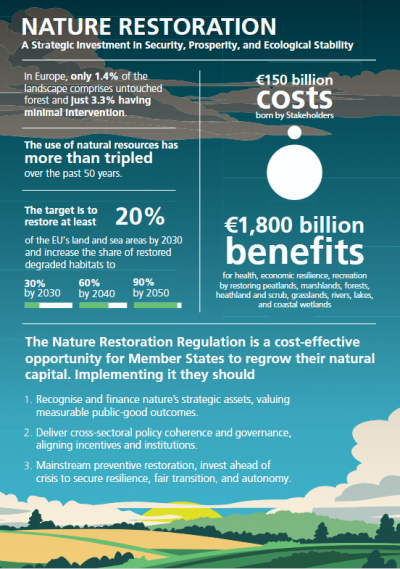
Europe faces rising climate-related damages, growing pressure on public finances, and urgent biodiversity losses. A new scientific commentary from the European Academies Science Advisory Council (EASAC) highlights how fully implementing the EU Nature Restoration Regulation (NRR; Regulation (EU) 2024/1991) is not just a legal requirement but a strategic investment in Europe’s health, security, and economic resilience.
The NRR sets legally binding targets to restore degraded ecosystems on land and at sea, requiring Member States to produce national restoration plans and align with broader EU policies including the Biodiversity Strategy, Green Deal, CAP, Water and Marine Directives, and Forest Strategy.
The Commentary 'Opportunities in Nature Restoration' finds that the estimated cost of restoring Europe’s ecosystems – around EUR 150 billion – is vastly outweighed by benefits at least ten times higher, including avoided disaster losses, improved public health, strengthened food and water security, and enhanced climate resilience.
“Nature restoration is not an environmental luxury. It is basic risk management,” says Prof Thomas Elmqvist, EASAC Environment Director and lead author. “At a time when Europe is spending billions responding to floods, droughts, wildfires, and health impacts, restoring ecosystems is among the smartest preventive investments we can make.”
EASAC warns that weakening or delaying NRR implementation would increase Europe’s exposure to climate extremes, economic losses, and health impacts.
“Environmental rollbacks do not eliminate costs, they merely shift them forward,”
says Prof Fiona Regan, Co-Chair of EASAC’s Environment Steering Committee.
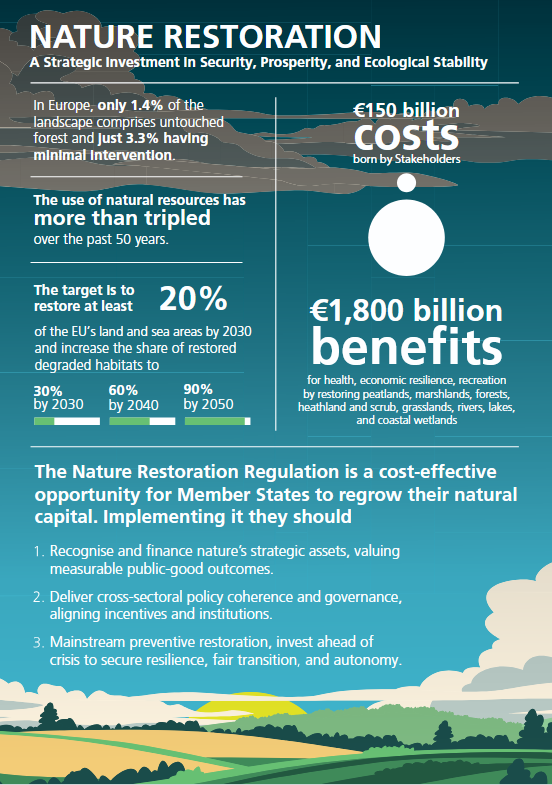 Commentary 'Opportunities in Nature Restoration' Infographic