News
Rosa Devés receives Inaugural Wynne Harlen Award at IAP-ISSE 2026 Conference
Other
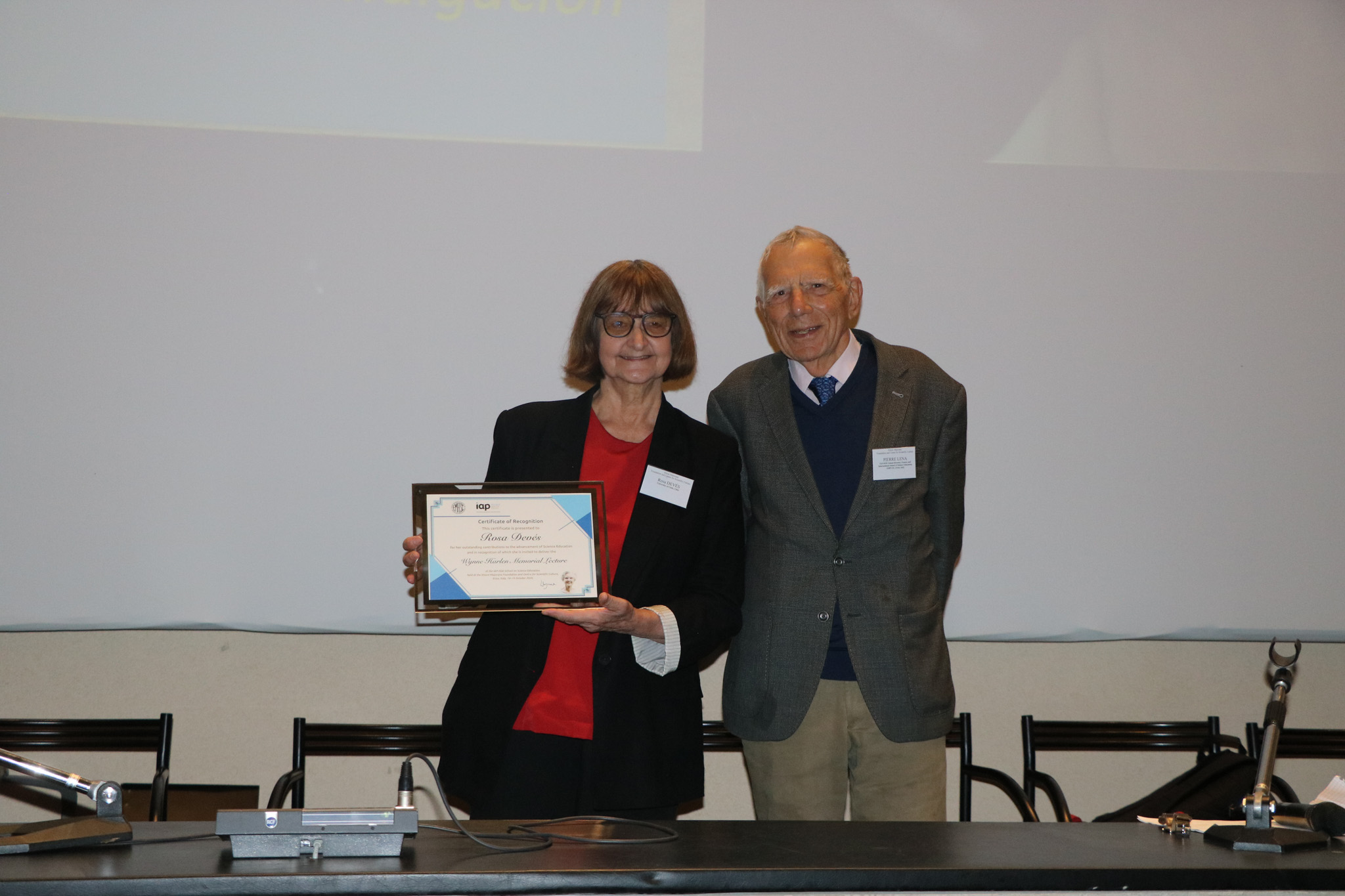
Rosa Devés has received the first Wynne Harlen Award, recognising her contribution to science education and inquiry-based science education (IBSE). She accepted the award at the InterAcademy Partnership-International School of Science Education (IAP-ISSE) conference in Erice, Italy, where she also delivered the Wynne Harlen Memorial Lecture. In it, she argued that science education must help young people navigate uncertainty, defend democratic values and build more inclusive societies.
The award follows a three-year cycle, with criteria set by the School Directors for each year. This first edition honours a renowned international expert whose research and advocacy support the implementation of IBSE, with particular consideration for those who have worked with Wynne Harlen to develop and promote the Big Ideas in Science Education. In the following two years, the award will recognise people or organisations that have implemented IBSE in schools, first across a world region and then within their own country.
Delivering the lecture on 17 October 2026, Devés emphasized the role of science education in developing scientific understanding and in fostering critical thinking, dialogue and trust at a time of increasing polarization, technological disruption and uncertainty about the future. Drawing on experiences from Latin America and the legacy of renowned science educator Wynne Harlen, she called for stronger partnerships between scientists, educators and communities to ensure that science remains a force for inclusion, citizenship and peace.
The full text of the lecture, which was introduced by Pierre Léna (Académie des Sciences; Université Paris Cité, France) and Michael Reiss (University College London, Institute of Education, UK), follows below.
I am profoundly grateful for this recognition and for the invitation to deliver the Wynne Harlen Lecture. I accept this honour on behalf of all those whose talent and generosity have made our work possible, in Chile and across Latin America.
I would especially like to acknowledge Professor Jorge Allende, whose wisdom and humanity have given strength and spirit to our work for so many years. I am also deeply indebted to Pilar Reyes, the executive director of our programme, and to the whole ECBI team, for their belief in quality science education and their steadfast commitment to this work.
However, above all, this recognition belongs to the teachers, children and young people whose curiosity and eagerness to learn and understand give meaning to everything we do.
We all admired and loved Wynne Harlen.
Wynne was a teacher and a friend, and she embodied a special combination of intellectual rigour, courage, gentleness and deep commitment to others. She brought these qualities together with a grace and balance that few achieve.
For many of us, our involvement in science education has been life changing. While rooted in an appreciation of the value of science, it has also been guided by the conviction that we must contribute to building a more just society, one in which every person is recognised in their equal dignity and where we all can stand together as equal citizens.
But we live in complex times. We are witnessing growing polarisation and fragmentation, the rise of authoritarian governments, and an increasing concentration of power over knowledge, which, on the contrary, must remain open and flow freely.
The ability to distinguish what may be true from what is false, the capacity for discernment, may well become a matter of survival. This is one of the reasons why our gathering and our purpose to advancing science education are so important. People of different generations, professions, disciplines and cultures have come together to this meeting with the aim of learning from one another and building alliances that can make a difference.
Margaret Levi, Emerita Professor at Stanford University, has developed the concept of “communities of fate”.
As Levi says, we all belong to a community of fate. This means that we have aligned ourselves with other members of that community on the understanding that we care for one another because we are part of a shared history. It is the case of the family, the school, the workplace, a religious group.
But what really matters, Levi argues, is that we work to expand these communities, making them progressively more and more inclusive, by way of finding something that is important to us all, and that can bring us together.
This is why we must value the science education community that we represent, a diverse community that makes each of us better, more complete and more effective; and at the same time, we must embrace Margaret Levi’s invitation to open our communities and expand them.
We have heard how AI is intensifying the uncertainty already created by climate change and the fragility of democracy, with consequences for the hopes and aspirations of younger generations. In recent months, I have listened to bright young people, with extraordinary educational backgrounds, ask whether it is worth continuing to strive, pursuing in their chosen fields, or even having children in a society that may come to be controlled by a few.
People who, by every rational measure, have a fascinating world of possibilities ahead of them, yet they feel frightened and, in a sense, lost.
It is therefore our task to prepare citizens to protect and strengthen their freedom, to help them find their voice and make themselves heard, but also to listen to others, seeking to understand their perspectives, and engage in meaningful dialogue.
In Latin America, many dialogues are still waiting to take place, given the inequalities that persist across our societies and our rich cultural diversity. But this is not only a concern for developing countries. When science is trusted and respected, it can help foster dialogue across cultures and continents and, in doing so, contribute to peace.
There is no single way to teach and learn science. Whatever approach we choose, however, science education must reflect the way science itself advances, as a collective endeavour, in which error is part of the process and progress depends on trust among peers.
This is why setting out the principles of science education , as it was done by the work led by Wynne Harlen - that resulted in the book Principles and Big Ideas of Science Education - is so important.
There were discussions, then, about the level at which these principles should be formulated, since this would shape their definition. The decision was guided by what could be most useful in classrooms and for curriculum development—avoiding unnecessary sophistication, while ensuring that the concepts remained rigorous, accessible and useful to all.
The same approach guided the descriptions of the progression of the Big Ideas. I recall Wynne saying that they should be written in language close to what teachers and students would naturally use in conversation at each stage of development, becoming more technical as the concepts grew in complexity. All these descriptions were brought together in a single piece, making the progression visible.
That is how Wynne approached her work, by immersing herself in the experience of the classroom and the context in which learning takes place. We must never lose sight of this ethical commitment in our own work.
I would like to conclude by returning to Jorge Allende and his legacy.
Jorge has always been a peaceful man, yet one who is capable of moving mountains in pursuit of what he believes in. He practiced science as a leading researcher in molecular biology, while also building international networks, collaborating with the school communities to improve science education, and opening opportunities for young scientists to share their knowledge in multiple ways. But he did not do this alone, and he was always grateful of the inspiration he drew from others.
When he introduced Pierre Léna and Bruce Alberts, in the ceremony that they became members of the Chilean Academy of Sciences in 2016, he recalled the historic meeting held in Tokyo, on Transition to Sustainability in the 21st Century, and said: “I remember very vividly that session because, for me, it was a moment of discovery, of epiphany in biblical terms, because it opened for me a new concept, since both Bruce and Pierre spoke of what their academies had been doing with inquiry-based science education of children in primary education.
“The epiphany that I received at the Tokyo Conference from the presentations of Bruce Alberts and Pierre Léna was very potent, because this new method of teaching gave the scientific community a very active role in participating in the implementation of inquiry-based science education in schools at all levels. The participation of scientists in the professional development and initial training of science teachers became essential, and the development of new teaching modules became a joint venture between scientists and educators.”
This sense of wonder is what we must keep alive, to remain not only curious, but also open to inspiration, by the remarkable people that we are fortunate to have around us.
Thank you very much.