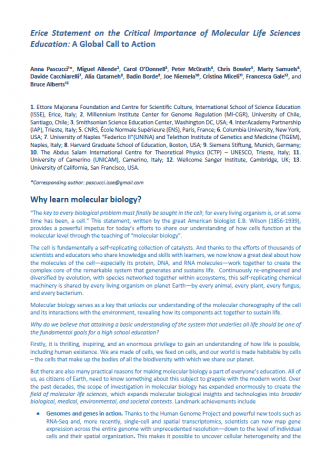
The Erice Statement makes a clear and urgent case for placing molecular life sciences at the heart of education. It argues that understanding how life works at the level of cells, DNA and proteins is no longer a specialist topic. It is essential knowledge for anyone trying to make sense of today’s world.
Drawing on decades of scientific progress, the statement shows how breakthroughs in genomics, gene editing and new technologies are reshaping health, food systems and the environment. These advances affect daily life, yet many people lack the basic understanding needed to engage with them. The authors point to this gap as a serious risk, one that became visible during the COVID-19 pandemic.
The statement calls for a shift in how science is taught. Instead of focusing on memorizing facts, it promotes inquiry-based learning that helps students ask questions, work with evidence and understand how scientific knowledge is built. This approach aims to develop curiosity, confidence and the ability to think critically about complex issues.
At the same time, the statement highlights the broader value of molecular life sciences education. It prepares people to make informed choices about health, environment and technology. It also helps strengthen trust in science by showing how evidence is generated and tested.
To move this vision forward, the authors propose the creation of a Global Alliance for Molecular Life Sciences Education. This effort would connect educators, researchers and institutions across countries to share knowledge, support teachers, and improve access to quality science education.
The message is simple but powerful. A better understanding of life at the molecular level can help build a more informed, more resilient and more connected global society.