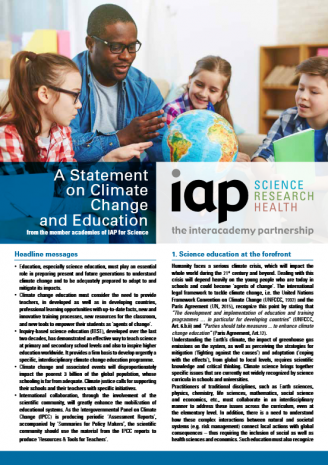

Statement on Climate Change and Education

For the remainder of the 21st century and beyond, climate change poses an existential threat to humanity.
Decisions on how to tackle the effects of climate change, however, need to be based on sound science and rational judgement. They will also need to be made through the coming years – so it is the younger generation, currently in schools and learning about science, who will need to make those decisions.
The Paris Climate Agreement (UN, 2015) recognizes this by stating that “Parties should take measures ... to enhance climate change education” (Paris Agreement, Art.12).
Unfortunately, in many countries, science education is often poor and does not develop the rational thinking or provide the inter-disciplinary study required to learn about climate change. IAP and its member academies have a strong track record in trying to improve science education by promoting inquiry-based science education (IBSE) through its Science Education Programme, which has been active since 2003.
Now, the member academies of IAP for Science have come together to endorse a ‘Statement on Climate Change and Education’ that lays out a series of recommendations on how effective climate change education can be promoted in schools around the world, including by using the periodic Intergovernmental Panel on Climate Change (IPCC) ‘Assessment Reports’ and accompanying ‘Summaries for Policy Makers’ as the basis for producing ‘Resources & Tools for Teachers’.
The IAP for Science ‘Statement on Climate Change and Education’ will be released on 11 December in Paris, France, at the One Planet Summit, being held under the auspices of the President of France, Emmanuel Macron.