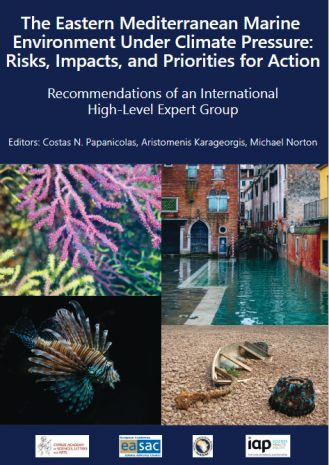
The Eastern Mediterranean is one of the world's fastest-warming regions, with temperatures increasing at nearly twice the global average. Its marine environment, a vital source of biodiversity, food security, livelihoods and economic activity, is increasingly under pressure from rising sea temperatures, marine heatwaves, sea-level rise, ocean acidification, declining oxygen levels and the spread of invasive species. Combined with growing human pressures, these changes are reshaping ecosystems and placing coastal communities, fisheries, aquaculture, tourism and cultural heritage at increasing risk.
Made possible through an IAP competitive grant, the report 'The Eastern Mediterranean Marine Environment Under Climate Pressure: Risks, Impacts and Priorities for Action' brings together the latest scientific evidence from an international group of experts coordinated by the Cyprus Academy of Sciences, Letters and Arts in collaboration with the European Academies' Science Advisory Council (EASAC) and the Network of African Science Academies (NASAC). The assessment synthesises current scientific understanding of the region's rapidly changing marine environment and identifies priorities for adaptation and policy action.
The report finds that many climate-related changes are unfolding faster than previously anticipated. Marine heatwaves are becoming more frequent, longer as well as more intense, while rising sea levels are increasing risks for coastal infrastructure and communities. Ocean acidification, warming waters and biological invasions are already altering marine ecosystems, threatening biodiversity and economically important sectors such as fisheries and aquaculture.
Beyond documenting these risks, the report identifies practical priorities for action. It calls for stronger marine monitoring systems, improved climate and ocean modelling, expanded early warning systems, enhanced surveillance of invasive species and greater investment in research. It also highlights the need for long-term adaptation planning, stronger marine protected areas and closer scientific cooperation across national borders.
The report concludes that addressing the challenges facing the Eastern Mediterranean will require sustained scientific collaboration, evidence-based policymaking and coordinated regional action to strengthen resilience and safeguard one of the world's most important shared marine environments.